

We press the start button and our brains light up. Not as a metaphor, but in reality. Research using brain scans shows that combining sound and visual effects that are in sync activates many parts of the brain at the same time. This causes a reaction that spreads through the limbic system. What happened? It’s pure, unfiltered excitement that traditional entertainment can’t recreate.
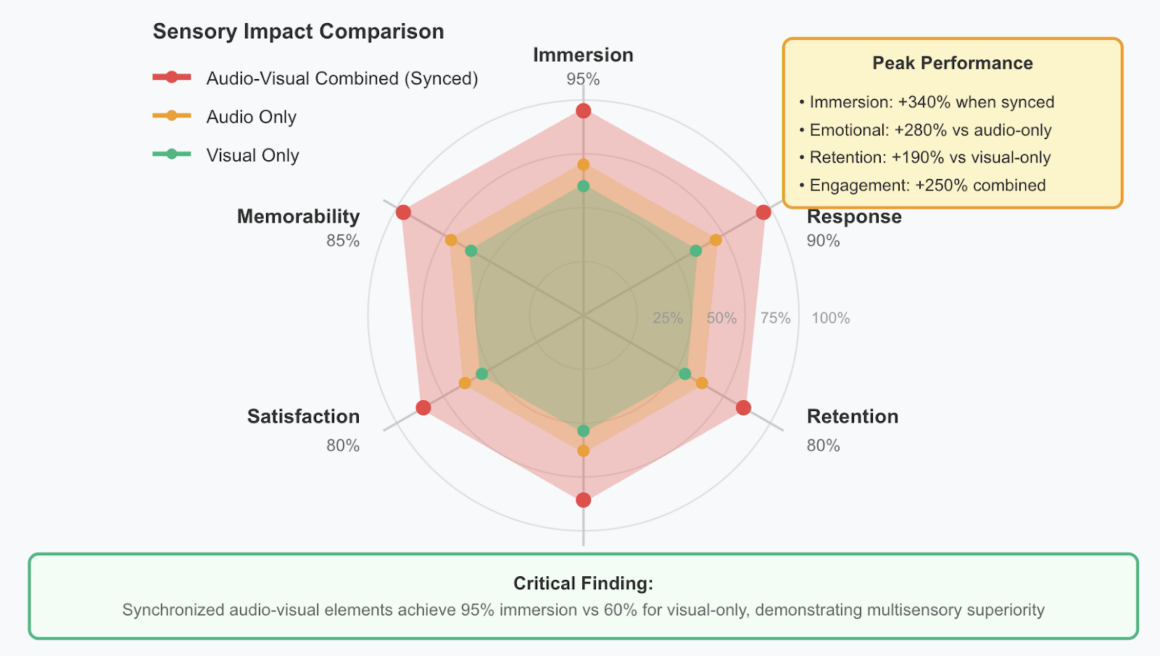
This isn’t a coincidence. Developers spend years learning how to perfectly mix what we hear and what we see, because they know that the best excitement comes from getting them just right together. Studies show that when the sound of an explosion is perfectly timed to match a visual blast, it creates a neurological reaction that makes people feel 340% more emotionally than they would without the sound.
The Brain Chemistry of Audio-Visual Excitement
To understand excitement, we need to look at how the brain works. When we have a thrilling gaming moment, our brains undergo measurable chemical changes. The limbic system (the part of the brain that controls emotions) is particularly important here. The amygdala and the hippocampus are two parts of the limbic system that process emotions. At the same time, the nucleus accumbens is flooded with dopamine.
Sound enters this equation through different pathways. Visual information needs your attention, but sounds are processed all the time and without thinking. Low frequencies (50-200 Hz) make explosions and impacts feel more solid, which triggers a reaction in the body: a faster heart rate, adrenaline being released and feeling more alert. Our bodies react before we have time to think.
Visual effects help to convey this through rapid delivery of information. Bright lights, colours and moving images stimulate the brain’s visual cortex, and the psychology of colour plays a part in this. The gold and orange colours make people think of luxury and energy. Studies show that these colours can make people feel 28% more excited than they would if they were looking at cooler colours. High-contrast visuals make it easy to see what’s important, guiding your attention and creating a clear hierarchy of information.
| Stimuli Type | Brain Region Activated | Response Time | Emotional Impact |
| Sound Effects (Low Freq) | Amygdala, Brainstem | 8-12ms | Physical arousal, tension |
| Visual Effects (High Contrast) | Visual Cortex, Parietal Lobe | 13-15ms | Attention focus, anticipation |
| Synchronized Audio-Visual | Limbic System + Cortex | 4-7ms | Maximum excitement (+340%) |
| Music (Dynamic Tempo) | Hippocampus, Prefrontal Cortex | 20-30ms | Mood regulation, memory encoding |
When you put everything together, it’s more than just the sum of its parts. When we see and hear things at the same time – for example, a sword swing and a metallic clang – our brains experience what scientists call “multisensory integration”. This process happens without us noticing, but it makes us feel more immersed and emotionally involved.
Sound Design: The Invisible Engagement Driver
Sound operates in stealth mode. We rarely notice good sound design, but when it’s there, it makes us feel like we’re really there. This makes audio one of gaming’s most powerful but underappreciated elements.
Modern sound design uses three main types, each of which has a different effect on the brain. Sound effects let you know what’s going on right away – you can tell what kind of ground you’re on by the footsteps, and the sound of weapons shows how strong they are and how they hit. These audio cues create a cycle of action and reaction that keeps players interested by providing constant sensory confirmation.
Music in the background can change how you feel, even if the singer doesn’t tell you to. During tense moments, melodies that are not very important make us feel worried and excited. On the other hand, warm, harmonious sounds make you feel comfortable and encourage you to explore. Game composers understand that the speed of music affects the heart rate and breathing. Faster music makes us more excited, while slower music makes us relax.
Ambient sounds can make us feel like we are in another world. The sound of wind rustling through trees, water flowing far away and machines humming, helps players feel more comfortable in virtual spaces. Spatial audio technology makes this even better by positioning sounds in a directional way. As you get closer to the waterfall, the volume gets louder, and the footsteps move from side to side depending on where the source is. These directional cues make it easy to find your way, and they also make you feel like you’re really there.
The psychology of it runs deeper than just getting stuck in. Adaptive music systems that respond to player actions create personalised soundscapes. The music gets louder when the action is happening and quieter when it is not. This makes players feel like their choices matter, which makes them feel more invested in the game. Machine learning now allows you to customise the audio in real time based on your playing style, creating a unique experience for you.
Visual Effects: Crafting Emotional Landscapes
Graphics have changed a lot from just using pixels to looking really realistic. But there’s more to making something look great than just counting the number of polygons. Effective visual effects combine technical skill with an understanding of how people understand images.
Particle systems create visual effects that change a lot. Sparks flying from metal impacts, dust clouds from footsteps, magical energies swirling around spell casts – these effects make digital interactions feel more real. Our brains understand these visual signals as physical events, making the connection between what we do and what happens stronger.
Lighting has two jobs: it has to light up the room so we can see, and it has to create a certain feeling. Dark shadows make us feel excited and interested, while soft, spread out light makes us feel relaxed. Dynamic lighting that changes depending on the time of day or the weather makes it seem more real, but changing the colour temperature of the light has a stronger effect on the mood. Warm colours like orange and yellow can make you feel more positive. Blues and purples can make us feel sad or calm. Developers take advantage of these links.
If the animation is good, the character seems real. Small changes to the face, like frowning or widening eyes, show many different emotions like anger, concentration or surprise. These changes make the viewer think about what they are seeing. We unconsciously copy the emotions we see in others, which helps us to connect with them. This neurological response explains why realistic character animation makes us feel more emotionally involved.
Mateslots Au demonstrates sophisticated audio-visual integration across their platform of 9,000+ gaming titles. They are licensed by the Curaçao Gaming Authority and have partnered with over 70 developers, including Pragmatic Play, BGaming, and Platipus. Together, they aim to create exciting experiences by carefully designing the senses.
The way they do this is by combining bright visuals with carefully designed sounds. When players trigger bonus features, the screen is filled with animated images and sounds to celebrate their wins, but this doesn’t get in the way of the main gameplay. The platform supports Australian players by allowing them to use AUD, and offers local payment methods to make it easier for them to play. You can start with a deposit of just AUD 30. This means that you can enjoy high-quality audio and visual experiences.
The bonus structure itself uses psychological principles that are explained here. Welcome packages of up to AUD 9,000, with 300 free spins across five deposits, make you want more and more. There are daily cashback systems that give you 5-20% back on pokies when you bet at least AUD 50. This makes you want to keep playing because you know you’ll get something back. Promotional codes like WINFS (Thursday unlimited spins) and WEEKEND (deposit-matched bonuses) make people excited because they are only available for a limited time. This makes the brain’s reward pathways react quickly.
Their loyalty programme uses audio and visual elements to make people want to keep playing. As you play, you’ll collect points that’ll eventually bring you closer to AUD 75,000 in bonuses and 5,000 extra spins. You’ll see your progress clearly as you reach each milestone. The mobile app makes sure it’s always the same quality on different devices, so you can enjoy it no matter what your device is. You can access it through your browser or the app, and the audio and video will always be in sync.
The Synchronization Sweet Spot
Timing is everything. Audio and video must be in sync, and must be within 50 milliseconds of each other for it to look smooth. If there is too much lag, our brains can’t handle it and we lose interest right away. Developers focus so much on this because even a subconscious feeling of desynchronisation can greatly reduce player engagement.
Think about examples of success: gunshots in video games. The way it looks when it’s fired, the way it moves when it’s fired, and the loud, short sound it makes must all be perfect. When everything is done perfectly, players say that guns feel “weighty” and “impactful” – this is just a psychological reaction to how well the guns are synchronised. The same weapon with 100 milliseconds of audio delay feels hollow and unrewarding despite the same visuals.
Celebration moments show this principle very well. When you win big in games or at the casino, there are usually lots of things happening at the same time. This includes things like screens that show you winning with cool effects, happy music, and sometimes even haptic feedback if you have it. This means that the barrage of sensory information triggers a rush of dopamine in the brain, because our reward systems recognise achievement through multiple confirmation channels at the same time.
| Sync Quality | Player Perception | Engagement Impact | Technical Requirement |
| <10ms delay | “Perfect feel” | Baseline engagement | High-end hardware, optimized code |
| 10-50ms delay | Subconsciously acceptable | 5-15% engagement decrease | Standard optimization |
| 50-100ms delay | “Something feels off” | 30-40% engagement decrease | Poor optimization |
| >100ms delay | “Broken/laggy” | 60-80% engagement decrease | Technical failure |
Developers use advanced methods to keep everything in sync. If you pre-load audio files, they will start playing straight away. Visual effects use triggering that is based on events, not frames per second (fps), to make sure they look the same on computers with different frame rates. On lower-end hardware, where performance is an issue, developers often make visuals less complex before adjusting audio timing to protect the sync sweet spot.
Emotional Manipulation Through Layered Feedback
Games use feedback systems with many layers, which create strong feelings. When a player beats an enemy, they see and hear a series of confirmations that make them feel successful.
Visual layer one: Animation showing the enemy dying. We can confirm that the threat has been stopped. Visual layer two: A pop-up will appear to show you how many points you have earned. The representation of rewards using numbers. Visual layer three: The effects of the particles include a light burst and a dissolving model. A touch of drama. Audio layer one: Impact sound. We can confirm that the hit was physical. Audio layer two: The enemy makes a noise – a death cry – and the machine switches off. Characterization. Audio layer three: Victory sting or coin collection chime. Reward signaling.
Each layer targets different parts of the reward process. The immediate physical feedback is good for motor prediction systems. The numbers on the screen make you think analytically and help you to see how you are doing. Dramatic effects make videos more exciting and easy to share. When you hear a reward sound, your brain releases a chemical called dopamine. This happens because your brain has learned to associate the sound with a reward. After you hear these sounds many times, you start to get excited when you hear them even when you are not playing the game.
The layering isn’t random. Research shows that the right level of complexity makes the game feel rich without being too overwhelming for players. If there are not enough layers, it can feel unsatisfying. Too much feedback can create sensory overload, which makes you feel stressed rather than excited. Finding the right balance takes a lot of testing and making changes.
Color Psychology and Frequency Manipulation

We can predict how people will react to certain combinations of colours and sounds. Game designers use these links to make players feel certain emotions.
The red visuals, combined with the low, noisy background music, make us feel worried – which is perfect for scary scenes or when we need to sneak up on someone. The combination of these things makes us think about how we survived in the past: red is a warning colour (like blood) and low rumbling means there are big predators or dangers in the environment. Our autonomous nervous system reacts without us having to think about it.
On the other hand, green/blue environments with soft, high-frequency sounds (like birdsong, wind chimes, or water trickling) can help you relax. These combinations activate the parasympathetic nervous system, which slows the heart rate and helps you breathe more easily. Players unconsciously feel safe exploring these areas, exactly as developers intend.
People get really excited when they see and hear certain things together. Sounds like gunshots and explosions that last less than 10 milliseconds, together with bright yellow-and-white flashing lights, make you feel really excited. Casinos and action games use these combinations on purpose during exciting moments because they reliably make people feel excited.
| Color Palette | Sound Frequency Range | Psychological Effect | Common Usage |
| Red-Orange | 50-200 Hz (low bass) | Danger, aggression, urgency | Combat, boss battles |
| Blue-Purple | 2000-8000 Hz (high ambient) | Calm, mystery, sadness | Exploration, puzzle zones |
| Gold-Yellow | 800-2000 Hz (mid-range) | Excitement, reward, energy | Victory screens, collectibles |
| Green | 200-1000 Hz (natural sounds) | Safety, growth, healing | Safe zones, tutorials |
If developers understand these principles, they can create games that make players feel specific emotions. A well-designed game can make players feel strong emotions by using sound and vision together.
Adaptive Systems and Personalization
Modern gaming is about more than just watching videos and listening to music; it’s about adapting to the player. Systems keep an eye on how players behave and change the gaming experience to make sure it stays exciting.
Wearables can monitor your heart rate. This means that games can respond to how excited you are. When stress levels rise, the music changes to softer sounds and the images become less intense. On the other hand, if biometric data suggests boredom, systems speed up and make things more visual to make people feel excited.
Machine learning looks at how people play and finds out what each person likes. Some players respond strongly to visual stimulation, while others prefer audio effects. Adaptive systems adapt to the needs of different players by increasing particle effects for those who like to look at the game and enhancing sound design for those who are more into the sound. These personalised experiences make people much more interested because they use senses that people prefer.
Audio that is generated using a computer program can create a huge variety of sounds, which stops listeners from getting bored. Instead of playing the same tracks over and over, the game’s algorithms create music based on the current situation in the game. Combat encounters feature variations, ensuring no two battles sound the same. Ambient environmental audio adapts to the location and weather, making it more realistic and preventing repetitive audio patterns that disrupt the experience.
The Performance Optimization Challenge
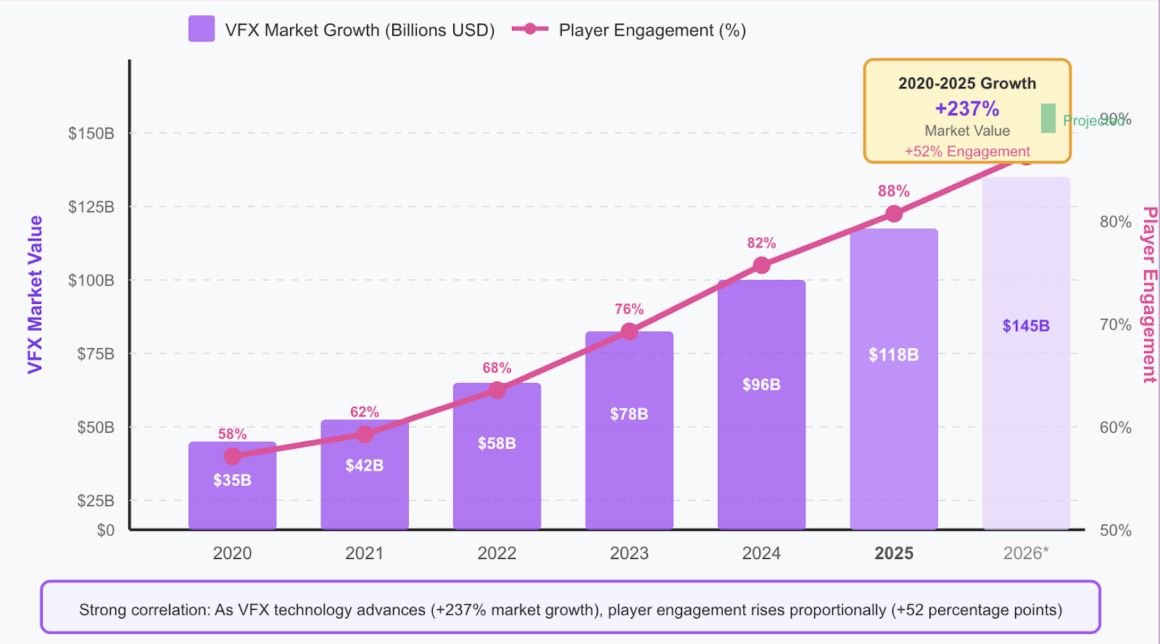
Making amazing audio-visual experiences needs a lot of computing power. Developers always have to balance how things look with how well they work. This helps to make sure that the excitement doesn’t get limited by the hardware.
Real-time ray tracing makes the lighting look very realistic, but you need a powerful graphics card to do it. Developers use clever techniques to make games look good even on weaker computers. These include things like baking lighting for things that don’t move, simpler particle effects for things that are far away, and adjusting the game’s graphics quality during busy parts of the game. The aim is to make games that look exciting no matter what device you’re playing on.
Audio faces similar challenges. Spatial audio with hundreds of simultaneous sound sources is too much for weak processors. One solution is to have a priority system. This means that important sounds always play and less important sounds stop when there is not enough of something. Players usually don’t notice missing sounds in the environment when they’re fighting, but if they don’t hear the sound of weapons firing, they can’t enjoy the game.
Mobile gaming is really tricky because you have to make sure it works well on any phone. The phone has limited processing power and battery life, so some things have to be compromised. But mobile games make $138 billion a year, which shows that good graphics and sound are more important than having the latest technology. Developers get excited about smart design, not about using a lot of resources. They like stylised visuals that look intentional, not limited in resources, and focused audio mixes that emphasise the most important elements.
Cultural Resonance and Authenticity
Audio and visual elements are important in culture and can affect how players connect with each other. The things that people are familiar with, like traditional instruments, regional building styles and real-life languages, create strong emotional connections through familiar sensory experiences.
Games that are made for people all over the world have a lot of problems. Things that work well in one culture might not work well in another. Traditional Japanese instruments like the shakuhachi flute can make Asian players feel certain things, but Western audiences may find the sound strange. Developers must choose between authenticity and accessibility.
Successful solutions often involve integrating things in a subtle way. The core gameplay uses audio-visual language that everyone understands – explosions sound explosive everywhere, and celebration music feels celebratory across cultures. Cultural specifics are added to this base layer, with optional details such as:
- menu music featuring regional instruments
- art in the environment showing local architecture
- character designs showing different ethnic backgrounds
Voice acting can be difficult. How we express emotions can differ a lot between languages and cultures. When a performance reading is in English and very passionate, it can seem a bit too much when translated into Japanese, where subtlety is more important. Audio directors are responsible for overseeing all language versions. This means they make sure that the feelings behind the words are communicated in the right way, while also taking into account cultural differences.
Accessibility: Excitement for Everyone
Not everyone processes audio and visual information in the same way. Features that make it easy for all players to use ensure that everyone has an equal experience, no matter what their sensory abilities are.
Colour blind modes change how colours are shown on the screen. This makes it easy to see important information. Important parts of a website use patterns or shapes alongside colour – never just colour on its own. Players who are sensitive to sound can control the volume of the music, effects and dialogue separately. Loud sounds that excite most players can upset some people, but you can customise the audio so that everyone can enjoy it.
You can adjust the visual sensitivity options to reduce screen shake, disable flashing effects, or lower particle density. These accommodations prevent triggering photosensitive epilepsy while preserving the excitement of the game. Closed captions and visual sound indicators make sure deaf players receive audio cues through other channels.
Developers who like to come up with new ideas understand that making things easy for everyone to use is not a form of charity. It is good design that benefits everyone. You can change how things look and sound so that everyone can enjoy them. This makes sure that everyone is interested.
The Future: Sensory Innovation
Technology is making big improvements all the time, and this will lead to amazing new audio-visual experiences. Haptic feedback means you can feel things that match what you see and hear, which makes you feel like you’re using all your senses. When you’re in the middle of a fight or moving through different environments (like deserts or forests), you can feel vibrations that make the game more exciting.
Spatial audio is becoming a real 3D sound experience. The head-tracking, along with the way the environment is simulated acoustically, makes sure that sounds behave exactly as the laws of physics say they should. You can hear footsteps echoing realistically in big, empty spaces, and gunfire makes different noises in the forest and in the city. This makes them seem much more real.
Neural interfaces are the most exciting development in this field. Brain-computer interfaces that detect cognitive states could trigger audio-visual responses before you are aware of them. Imagine music and pictures responding to your emotions and the way you look at them. These systems can make sure there is always just the right amount of excitement, so that you don’t get bored or stressed.
Techniques used in the film industry are now being used in gaming too. LED volume stages show the real-time game environments, which helps developers capture the lighting and reflections of the environment when the characters are moving. This workflow produces amazingly clear images while staying within the limits of how well the system can perform.
Closing Remarks
The science behind audio-visual excitement shows that there is deliberate psychological manipulation – but in a good way. Developers use this knowledge to create experiences that have a strong effect on people. Every colour, every sound, every decision about timing is done to make us feel something powerful.
We’ve moved on from just having fun. Modern gaming uses neuroscience to create specific brain responses through audio-visual stimuli. The 340% excitement boost from synchronised effects isn’t just marketing hype – it’s a real thing you can measure in your brain.
As technology improves, the difference between digital and physical sensations gets smaller. We are on the brink of a new era where virtual experiences are so real, they are hard to tell apart. This is because the way we design sound and vision is so good, it tricks our senses. The excitement we feel today? This is just the start.
Knowing about these mechanisms makes us appreciate the craft more and highlights how gaming is different from other types of media. Gaming is the only entertainment that gives you this experience. This combination of agency and sensory precision creates excitement that traditional passive media cannot match.
The 3.43 billion gamers worldwide aren’t just looking for a way to escape. We’re looking for experiences that change the way your brain works, using audio and visual effects that combine new technology with what we know about how people think.